Friday, November 13, 2026

Why Crypto Prices Go Up and Down As Bitcoin Hits New Lows

Why Crypto Prices Go Up and Down As Bitcoin Hits New Lows
Photo: Openverse

Bitcoin dropped to its lowest point since August today, pulling down other coins like Ethereum and Solana. Big market shifts are making everyday prices swing fast, leaving many new users asking why their account balances look so different from one morning to the next. If you hold any digital coins, watching these rapid changes can feel like a wild ride on a roller coaster.

Crypto prices move because people buy and sell them constantly on open markets without any central authority setting a price. When more buyers want a coin than sellers, the price moves up. When sellers rush to get out and few people want to buy, the price drops quickly. Learning the forces behind these sharp shifts helps you look at market dips without panic.

What Is Supply and Demand in Crypto Markets?

Prices change mostly because of basic supply and demand. Think of digital coins like rare trading cards at a school yard swap. If everyone wants the same card, the kid holding it can ask for more snack trade items to hand it over. If no one wants that card anymore, the price drops until someone finally takes it off their hands.

Every digital coin has a total number of coins that will ever exist. Bitcoin has a hard limit set into its code, which keeps new supply tight over time. You can learn more about how Bitcoin limits its total supply on open networks. But demand changes every hour based on news, human fear, and fresh hopes. When news reports show big drops across the market, many buyers step back, causing supply on exchanges to outweigh active orders.
Why Crypto Prices Go Up and Down As Bitcoin Hits New Lows
Photo from the web

Why Did Bitcoin, Ether, and Solana Fall Today?

Today, market updates show Bitcoin hitting fresh lows for recent months. Ethereum sank down toward the $2,000 line, while Solana dropped to around $81.27. These drops show how connected the entire digital market is right now. When the biggest coin loses ground, smaller coins often take an even bigger hit.

Several things caused this recent decline across popular coins. Big investors often sell off risky assets when they get nervous about global cash flows or rising interest rates. When giant funds sell millions of dollars worth of coins at once, the exchange market fills with extra supply. If you are learning the trade, checking an India Exchange SunCrypto Adds Derivatives Guide as Crypto Words Matter post can help you get used to basic market terms without getting lost in the noise.

How News and Hype Drive Fast Changes

News reports can change market trends in just minutes. Good news, like a major company accepting digital payments, brings in thousands of new buyers. Bad news, like exchange hacks, tight government rules, or legal battles, makes people sell fast to protect their cash. Fear spreads far quicker than patience on the internet.

Social media chatter also plays a huge role in price moves. A single post from a famous leader can send a small coin soaring or crashing before lunch. Beginners often get caught in FOMO, which stands for the fear of missing out. They buy near the top because everyone is talking about it, only to watch the price fall when early buyers take their profit and leave.

The Power of Whale Traders

A whale is a person or fund that holds thousands of coins in one single account. Because these accounts are so large, one move from a whale can shake up the whole order book. If a whale moves millions of dollars to an exchange to sell, lower order prices get hit fast, causing a sudden price drop that triggers automated sell orders for small retail buyers.

Large funds also trade using math rules on computers. These trading bots buy and sell automatically based on set market levels. When Bitcoin crosses a key support line on the chart, hundreds of bots sell at the same second. This can turn a small drop into a sharp dive within minutes, making the fall look much worse than it really is.

How Beginners Can Stay Safe During Market Dips

Market swings are normal for digital assets, so you must protect your money from big shocks. Never put in cash that you need for rent, food, or real life bills next week. Expect prices to swing hard, and make a plain strategy before you buy anything.

Spread your risk across different places instead of placing everything on one trendy coin. Use steady habits, like buying tiny bits at regular times, rather than trying to guess the exact bottom. Keep track of general rules by looking over our main crypto market updates blog so you can stay informed without making emotional trades. To understand how underlying computer networks secure these coins during high trade volume, read about Blockchain history on open research pages.

Prices will keep moving as buyers and sellers react to daily events, new rules, and shifting tech. When you look past the noise, you can view market dips as normal events rather than an emergency. Have you set a plan for how you will handle the next big market drop?

India Exchange SunCrypto Adds Derivatives Guide as Crypto Words Matter

India Exchange SunCrypto Adds Derivatives Guide as Crypto Words Matter
Photo from the web

Learning new crypto words can feel like learning a whole new language when you first start. Trading platforms keep adding complex features, so understanding basic terms matters more than ever. A clear guide helps you avoid simple mistakes that cost real money.

Indian crypto exchange SunCrypto published a beginner guide for derivatives trading to help new users learn key terms safely. At the same time, platforms like Binance use daily word games to help people build their market knowledge. Getting these terms right keeps your money safe while you learn how modern trading works.

Why New Crypto Words Confuse Most Beginners

When you open your first trading app, the screen fills with terms you never saw in a regular bank. Words like spot, futures, pairs, and order books pop up everywhere. It feels hard because money is on the line while you try to translate what each word means.

Think about buying a basic item at a local shop. You pay cash, and you walk away with the item right then. That is what people call spot trading in the cryptocurrency market. But other features let people trade based on what prices might do later today or next week.

Most basic mistakes happen because people tap buttons without knowing the words attached to them. A user might think they bought real coins, but they actually signed a contract based on price movements. Taking time to learn the language removes that shock.

India Exchange SunCrypto Adds Derivatives Guide as Crypto Words Matter
Photo: Wikimedia Commons

The Basics Behind Crypto Words Every Beginner Should Know

Start with the core building blocks before looking at complex tools. A coin is digital cash that runs on its own network. A token is a digital asset built on top of an existing system. Knowing the difference stops you from sending funds to the wrong address.

Here are five simple terms you will see every day on exchanges:

  • Wallet: The tool that holds the private keys to your coins.
  • Exchange: A site or app where people buy and sell coins with each other.
  • Liquidity: How easy it is to change your coin into cash without losing value.
  • Bull Market: A period when prices go up for a long time.
  • Bear Market: A period when prices fall and stay low.

Understanding these words gives you a strong foundation. You can read market updates without feeling lost. You also spot risk much faster when an app asks you to approve a new transaction.

How Indian Exchange SunCrypto Is Helping New Traders

Trading platforms in Asia are expanding rapidly as more people try digital assets for the first time. Indian platform SunCrypto put out a guide for derivatives trading to explain advanced words in simple steps. Derivatives are contracts that get their value from an underlying coin like Bitcoin.

These financial tools carry far more risk than simple buying and selling. If a beginner jumps into contract trading without reading the rules, they can lose their full balance in minutes. Educational updates break down how use, liquidations, and margin calls actually work behind the scenes.

Government agencies across the globe keep a close eye on these complex trading products. News shows how the North Korea Crypto Hack Sees US Move to Take Back Funds, which reminds everyone that security and clear facts matter at every level of this industry.

Learning Crypto Words Through Games and Daily Rewards

Not all learning comes from heavy manuals or long blog posts. Major platforms try to make safety lessons fun so users stay sharp. Binance runs a daily game called Word of the Day where players guess market terms to earn small rewards.

This simple format forces players to read about security, account protection, and basic trading rules every day. Spending two minutes on a word puzzle builds good habits over time. It makes learning feel less like homework and more like a quick daily check-in.

When you review crypto basics for beginners, daily practice keeps safety steps fresh in your mind. Scammers often rely on confusing words to trick new people. When you know the proper terms, bad actors cannot fool you as easily.

Advanced Words You Will See on New Trading Platforms

Once you know the simple terms, you will run into words that describe automatic trading tools. These words sound complicated, but the ideas behind them are quite basic once you break them down.

Here are three intermediate terms to keep on your radar:

  • Slippage: The difference between the price you expected and the price you actually got.
  • Gas Fee: The payment you make to the network to process your transaction.
  • Cold Storage: Keeping your private keys on a hardware device that stays off the internet.

If you trade during busy hours, network traffic goes up and gas fees rise quickly. Slippage can also happen when prices shift in less than a second. Knowing these facts prevents unwanted surprises when your trade goes through.

How to Keep Your Assets Safe While You Learn

Never rush into trading tools you do not fully understand yet. Start small with basic purchases on trusted platforms before touching complex options. Keep your account safe with strong passwords and two-factor checks on your phone.

Read official guides directly from exchanges or trusted learning sites. Check every web address twice so you do not land on a fake site built by hackers. Asking simple questions on community forums helps clear up confusion before you make a move.

What is one new crypto word you saw today that you want to test out safely?

North Korea Crypto Hack Sees US Move to Take Back Funds

North Korea Crypto Hack Sees US Move to Take Back Funds
Photo from the web

An old digital wallet moved millions of dollars this week, right past a trap set by thieves. At the same time, officials in the US are acting to grab back over a billion dollars stolen in a huge attack on a major exchange. These events show how a crypto wallet works to keep your coins safe, but they also show how fast things can go wrong.

A digital wallet does not hold cash like a physical purse. It holds private keys, which are long secret codes that unlock your money on the network. When you move coins, your software uses these keys to sign the transfer. If you lose your keys or share them by mistake, someone else can take your funds in seconds.

How a Crypto Wallet Works to Guard Secret Codes

Every person who uses digital money has two main keys. One key is public, like an email address, so anyone can send you coins. The other key is private, like a password, and it must stay hidden. The software manages these codes for you so you do not have to type long strings of numbers every day.

When you send funds, your wallet writes a message to the public ledger. It signs that message with your secret code to prove you own the coins. The network checks the signature without ever seeing your private key. That simple trick keeps your cash safe while letting the whole world see that the deal is real.

Some people keep their secret codes on paper or on small USB devices offline. Others keep them in apps on their phones. If you use an online company to hold your coins, that firm holds the keys for you. You can learn more about how Stablecoins Stay Active Even When Big Banks Stop Working by keeping control of your own assets.

North Korea Crypto Hack Sees US Move to Take Back Funds
Photo from the web

Old Ethereum Wallet Moves Millions and Escapes Trap

A clear example of how these keys work happened just days ago. An old cryptocurrency wallet that sat quiet for 11 years suddenly woke up. It held millions in Ethereum. The owner moved $4.6 million out of the old address to a new home.

What makes this story wild is that bad actors set up a scam to steal the cash right as it moved. They set traps using fake web links and bad computer code, hoping the owner would make a mistake. The owner avoided the trap completely because their secret key stayed safe on their own device. The thieves could not sign the bad transfer, so the funds went where the real owner wanted.

Why does an old account moving cash matter to you? It shows that long random codes do their job if you never share them. Even after a decade, the network still honors the same secret key. No bank had to approve the move, and no company could block the owner from sending the money.

US Takes Action on Stolen Exchange Funds

While one user saved millions by using a private key, whole exchanges face bigger threats. Reports this week show the US government is moving to seize $1.2 billion in stolen cash linked to a massive hack on Binance. Investigators say hackers from North Korea took the money during a complex digital break-in.

When hackers attack a big site, they do not always steal your personal phone app. They go after the giant pots of cash stored on central servers. Once the thieves get those master keys, they move the funds to their own accounts fast. Government agents have to track those moves on the public ledger to try to freeze the funds later.

This big fight highlights the real risk of keeping money on web platforms. If an exchange loses its keys, your account balance can vanish overnight. That is why many users move their savings to personal apps or hardware tools where they control the keys themselves.

How Scammers Try to Trick Your Software

Hackers rarely break the math behind digital codes because that math is very strong. Instead, they try to trick you into giving away your keys. They build fake websites that look like real apps, or they send direct messages offering free tokens.

Here are basic ways people lose their money today:

  • They type their secret phrase into a fake site that promises free coins.
  • They sign a bad smart contract that gives a stranger permission to drain their balance.
  • They store their secret key in a plain text file on an internet-connected computer.

If you fall for one of these tricks, no customer service line can undo the deal. The network only checks if the signature is valid. It does not know if a hacker tricked you into making that signature.

What Is the Best Way to Keep Your Assets Safe?

If you want to store digital cash safely, start with small steps. Download a trusted software tool on your phone or buy a hardware device. Write your secret recovery phrase on paper with a pen, and store that paper in a safe place. Never take a photo of those words or put them in an email.

Always double-check web addresses before you connect your software to a site. If a deal sounds too good to be true, it is almost certainly a scam. You can check our guide on crypto basics and market safety to build better habits as you learn.

Do you prefer keeping your money on a big exchange, or do you want full control of your own keys? Taking charge of your own codes gives you total freedom, but it also means you carry all the responsibility. Take your time, test small moves first, and keep your secret words safe from prying eyes.

Stablecoins Stay Active Even When Big Banks Stop Working

Stablecoins Stay Active Even When Big Banks Stop Working
Photo from the web

Stablecoins are proving to be more than just a digital version of the dollar for traders. Recent news from Japan shows that people are looking at these coins as a safety net for when traditional banks have to shut down or pause their services. Mr. Okabe from JPYC recently pointed out that these digital assets keep moving even if your local bank branch has to close its doors during an emergency.

The main idea is simple: stablecoins are digital tokens designed to keep a steady value, usually tied to a currency like the US dollar or the Japanese yen. Unlike other coins that jump up and down in price, these are meant to stay at one price so you can use them for daily buying and selling. If a bank stops its operations, a stablecoin holder can still send money to a friend or pay for a service using their digital wallet. This makes them a backup plan for the money in your pocket.

Why stablecoins stay running when banks do not

When you use a normal bank, you are relying on their private computers and their staff to be awake and working. If their system crashes or they have a holiday, your money is stuck until they open again. Stablecoins are different because they run on a blockchain, which is a network of many computers around the world that never all sleep at the same time. This means the "bank" is always open, 24 hours a day, every single day of the year.

Think about a Sunday afternoon when you need to send money to someone for an emergency. A bank might take until Monday or Tuesday to show that money in the other account. With a stablecoin, the transfer happens in minutes. This speed is why experts like Mr. Okabe are pushing for more people to understand how they work. It is not just about investing; it is about having a way to move value when the old ways fail us. You can learn more about the basics in our guide on Stablecoins Explained Simply for Beginners in Today's Market to see how they fit into your life.

Stablecoins Stay Active Even When Big Banks Stop Working
Photo from the web

Samsung and the push for digital payments

It is not just small companies looking at this tech. Big names like Samsung are now looking at how stablecoin payments can help businesses work better. When a huge company like Samsung shows interest, it tells us that digital coins are moving away from being a hobby for tech fans and becoming a real tool for global trade. They see a world where a business in Korea can pay a business in London instantly without waiting for five different banks to talk to each other.

This shift matters because it forces old-school finance companies to wake up. If you can pay for your new phone or your monthly bills using a stablecoin, you might not need a traditional credit card for everything. However, this also brings new risks. If the company behind the stablecoin does not actually have the cash they claim to have, the coin could lose its value. This is why looking at the news and checking if a coin is regulated is a vital step for any beginner.

How do stablecoins stay at the same price?

You might wonder how a digital coin stays at exactly one dollar. Most of the time, the company that makes the coin keeps one real dollar in a bank vault for every digital coin they sell. This is called "backing." If you want to trade your digital coin back for a real dollar, the company uses that stash to pay you. This keeps the price steady because everyone knows they can get their "real" money back whenever they want.

Some newer types of stablecoins use math and code to keep the price steady instead of keeping cash in a vault. These are often called algorithmic stablecoins. They are much riskier for beginners because if the math fails or people lose trust, the price can drop to zero very fast. We have seen this happen before, and it serves as a big warning. Always check what is backing your coin before you put your hard-earned money into it. You can find more beginner guides on digital assets to help you tell the difference between safe and risky options.

The role of new rules and regulations

Governments are starting to watch stablecoins very closely. In recent days, we have seen news about things like Liv's USDU, which is a stablecoin that tries to follow strict rules to keep users safe. Regulation sounds like a boring word, but for a beginner, it is actually good news. It means there are laws that try to stop coin makers from lying about how much money they have in the vault.

When a coin is regulated, the company usually has to show proof of their holdings every month. This "proof of reserves" helps build trust. If you are looking for a place to start, picking a coin that is open about its audits is much safer than picking one that hides its data. Even with rules, remember that cryptocurrency is still a new world. No one can promise you that your money is 100% safe, so only use what you can afford to lose while you are learning the ropes.

Common risks for every beginner to know

While it is great that you can use these coins when banks are closed, you have to be your own security guard. If you lose the password to your digital wallet, there is no "forgot password" button like there is at a bank. Your money is just gone. Also, hackers are always looking for ways to steal digital coins. You must use strong passwords and never share your private keys with anyone, even if they claim to be from a support team.

Another risk is the platform you use to buy the coins. Some websites might make it easy to buy stablecoins but then make it very hard to move them to your own wallet. Always read the small print about fees. Some places charge you a lot of money just to move your coins from one place to another. If you are just trying to save a few dollars, these fees can eat up your money before you even get started.

What is the future for these digital dollars?

The goal for many people in this space is to make stablecoins as easy to use as a debit card. We are not quite there yet, but with companies like Samsung and leaders like Mr. Okabe pushing for it, the tech is getting better. One day, you might not even know you are using a stablecoin. You will just tap your phone at a store, and the blockchain will handle the rest in the background.

For now, the best thing you can do is watch how these coins behave during a market dip. Do they stay at one dollar, or do they start to wobble? Watching from the sidelines is a great way to learn without taking any risk. Does the idea of having a backup currency that works when banks are offline make you feel safer, or does the tech still feel too new for you to trust it with your money?

Stablecoins Explained Simply for Beginners in Today's Market

Stablecoins Explained Simply for Beginners in Today's Market
Photo: Openverse

Stablecoins are a simple type of digital money built to keep a steady value. While major coins like Bitcoin drop to low levels this week, stablecoins stay close to one set price like one US dollar.

They give you a safe spot to hold your money inside the crypto world without exiting to a normal bank account. If you want to understand how crypto works without losing sleep over wild price changes, learning about stablecoins is the best place to start.

What Is a Stablecoin and How Does It Work?

A stablecoin is a digital token designed to match the value of another asset. Most of them match cash, like the US dollar or the euro. If one dollar goes up or down in the real world, the token matches it.

Think of it like a ticket at a coat check. You give the attendant your heavy winter coat, and they give you a paper ticket. Later on, you hand back the ticket to get your exact coat back. A regular Cryptocurrency can jump around in value like a toy on a spring, but a stablecoin acts like that paper ticket.

How do they keep the price steady? The company behind the coin usually keeps real cash in a bank account for every token they create. If they issue one million tokens, they should have one million real dollars locked away in a safe spot. This backing gives people trust that the token is worth what it says.

Stablecoins Explained Simply for Beginners in Today's Market
Photo: Openverse

Why Do People Use Stablecoins Today?

People use these tokens to shield their funds when the wider market gets bumpy. Recent news shows Bitcoin falling to low prices not seen since late summer, which makes holding standard coins risky for short periods. Investors often swap their volatile assets into stable tokens to rest while they wait for the market to calm down.

They also make moving money fast and cheap. Sending cash through old banks across borders can take three days and cost big fees. Sending a dollar token takes a few seconds on a computer network.

Here are four common times people use them:

  • Locking in gains after a good week of trading.
  • Storing funds safely during a market crash.
  • Sending money to family in another country without big bank fees.
  • Buying other coins quickly without waiting for bank transfers.

You can read more about how market changes affect your money in our guide on Why Crypto Prices Go Up and Down During Market Shifts. It helps show why having a steady asset matters so much during quiet or wild market days.

What Are the Different Types of Stablecoins?

Not every stable token works the same way under the hood. Knowing the difference helps you pick safer options and avoid bad surprises.

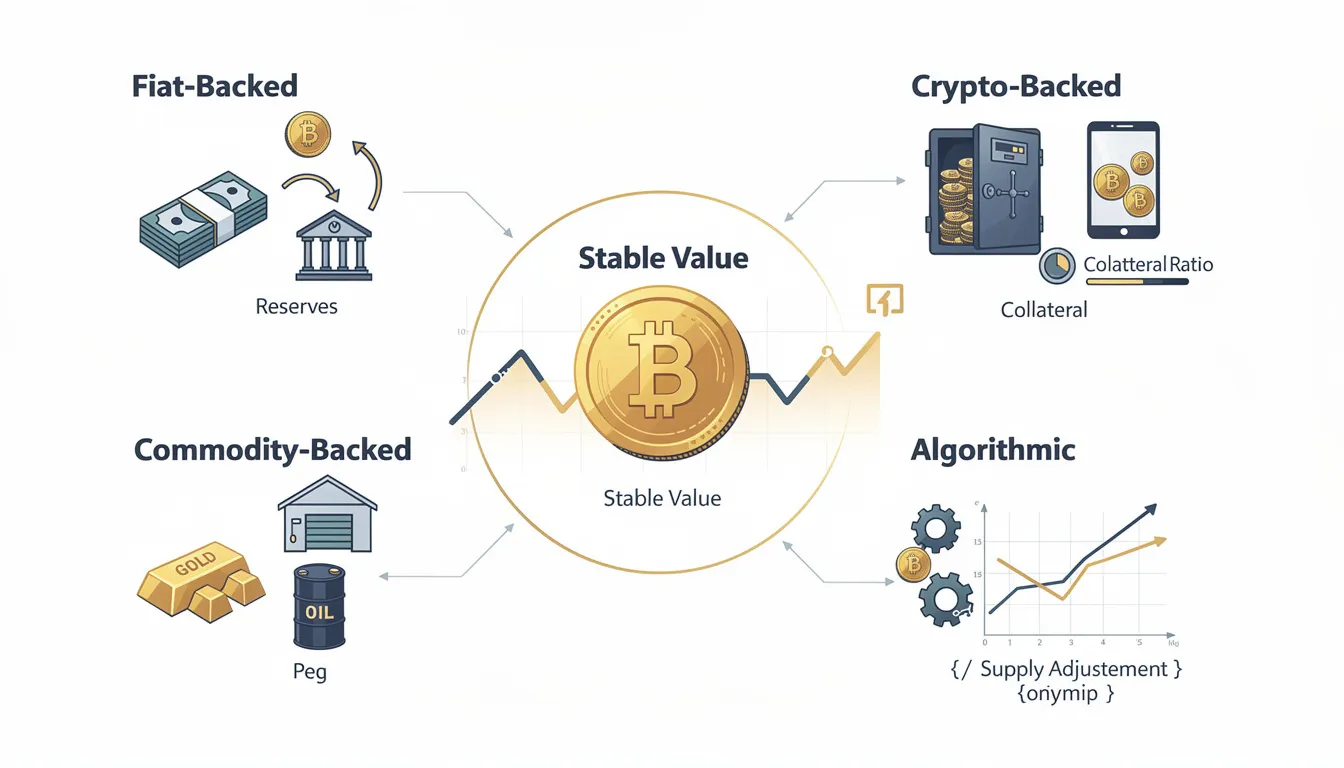
The first type is cash-backed tokens. A central business holds real paper money, short-term bonds, or gold in a bank vault. Tokens like Tether (USDT) and USD Coin (USDC) use this setup. They are the most popular kind because the math is easy to follow.

The second type uses other crypto assets as collateral. Instead of holding cash in a bank, a smart contract holds tokens like Ether inside a vault on the network. Because crypto prices move around, these systems make you put in extra tokens, like putting up two dollars of Ether to mint one dollar token.

The third type uses computer code and math rules to balance supply. These are called algorithmic tokens. They do not hold cash reserves in a bank. Instead, code mints or burns supply to try to hold the price at one dollar. History shows these carry much more risk, as the code can fail when too many people sell at once.

What Are the Risks You Should Watch Out For?

Stablecoins sound safe, but they are not the same as money in a insured bank. You must understand the risks before putting your hard-earned money into them.

First, a token can lose its peg. This happens when the market price drops below one dollar and stays there. If people panic and start selling, or if the backed cash disappears, the coin might drop to ninety cents or lower. If that happens, you lose money even though the name says stable.

Second, you have to trust the company managing the reserve funds. If a firm lies about how many dollars it has in its vault, the system can collapse. That is why smart buyers look for tokens that show regular reports from public accountants.

Third, tech bugs can happen. Since these tokens run on computer code, a bug in the system can let hackers steal funds. Always test new tools with small amounts first so you do not risk money you cannot afford to lose.

How Do You Get Started with Stablecoins Safely?

Getting your first stable tokens is simple if you take basic precautions. You do not need to be a computer wizard to do it right.

First, pick a well-known service that has a strong safety record. You can check out our main page on crypto updates and beginner guides to see how top platforms compare today. Look for platforms that use strong security controls and clear rules.

Next, set up two-step checks on your account. This sends a code to your phone or an app every time you sign in, which stops hackers even if they guess your password. Never share your security keys or secret phrases with anyone, even if they claim to work for customer support.

Finally, start with a tiny sum to see how transfers work. Send five dollars to your private wallet, check that it arrived, and test sending it back. Taking slow steps builds your confidence while keeping your money safe.

Which stable token will you research first for your own wallet?

Why Crypto Prices Go Up and Down During Market Shifts

Why Crypto Prices Go Up and Down During Market Shifts
Photo: Openverse

Prices for digital coins like Bitcoin often swing wildly in just a few hours. These sudden moves can make your money grow or shrink faster than almost any other investment. Understanding why crypto prices go up and down is the first step to staying calm when the market gets bumpy.

The short answer is that crypto prices depend on how many people want to buy versus how many want to sell. When big news hits, like a famous investor picking one coin over another, thousands of people might rush to buy at once. This sends the price soaring. If a long-time owner decides to sell everything, the price might drop just as fast. It is a giant game of supply and demand played out on screens across the world.

Big Investors Are Choosing Bitcoin Over Gold

Recent news shows that major money managers are changing their minds about where to keep their wealth. Jurrien Timmer from Fidelity lately pointed out that he favors Bitcoin even when the market sees a sell-off. This matters because when a huge company like Fidelity shows interest, it gives regular people more confidence. When confidence goes up, the price usually follows because more people feel safe buying in.

Gold has been the "safe" choice for hundreds of years. Now, some experts see Bitcoin as a digital version of that same safety. If thousands of investors move their money from gold into crypto, the price of crypto rises because the demand is suddenly much higher. You can learn more about the history of Bitcoin and how it became a rival to traditional assets to see how far it has come.

Why Crypto Prices Go Up and Down During Market Shifts
Photo: Wikimedia Commons

Why Does Bad News Make Prices Drop?

Fear is a powerful force in the crypto world. If people hear about a hack or a scam, they often get scared and sell their coins as fast as they can. This "panic selling" creates a chain reaction where the price falls, which scares even more people into selling. It is a cycle that can wipe out gains in a single afternoon.

Security is a major part of this fear. For example, staying alert about Crypto Scams and How to Stay Safe Using Binance Word of the Day can help you avoid personal losses, but big news about hacks affects everyone. When a large exchange has a problem, investors worry their money isn't safe anywhere. This loss of trust is one of the fastest ways to see a price crash.

The Impact of Long-Term Holders Selling Out

Sometimes, the people who have owned crypto for years decide they have had enough. A veteran investor who held XRP for seven years recently shared that they are tired and thinking about selling everything. When someone who has "diamond hands" (a term for people who never sell) finally gives up, it sends a signal to the rest of the market.

If these big players sell their large amounts of coins, the market gets flooded with supply. Since there are suddenly so many coins for sale and not enough buyers to take them all, the price has to go down to attract new interest. This is a common reason why prices stay flat or dip even when there isn't any "bad" news. It is just a matter of people wanting to turn their digital coins back into cash.

New Apps and Games Drive Prices Up

Crypto isn't just for trading; it is also used for games and new types of apps. Headlines about the best Web3 games for 2026 show that more people are using crypto to play and earn rewards. When a game becomes popular, thousands of players need to buy the game's coin to join in. This creates a steady stream of buyers.

Every time a new tool comes out, like the Robinhood Chain, it makes it easier for regular people to use crypto. Easy use leads to more users. When it is simple to swap coins or buy into a new project, the total number of people in the market grows. You can check out more beginner tips for understanding crypto to see how these new tools change the way we handle money.

How Trading Platforms Change the Price

Where you buy your crypto also matters. Places like Robinhood or big exchanges make it easy to click a button and buy. If a popular app adds a new coin, millions of people can suddenly buy it. This "listing news" often causes a massive price jump in just a few minutes because the coin is suddenly available to a much bigger crowd.

On the flip side, if an exchange stops supporting a coin, the price often tanks. People get worried they won't be able to sell their coins later, so they sell them immediately. The technical term for this is liquidity. High liquidity means it is easy to buy and sell without changing the price much. Low liquidity means even a small trade can move the price a lot.

Regulations and Government Rules

Governments around the world are still deciding how to treat cryptocurrency and its users. When a country says they might ban crypto, prices usually fall. When a country says they will make clear rules that protect users, prices often go up. Rules make big companies feel safe enough to invest billions of dollars.

It is not clear yet how every country will vote on these rules. This "not knowing" is called uncertainty. Markets hate uncertainty. If investors aren't sure what will happen tomorrow, they might take their money out today just to be safe. This is why you often see prices jump around when politicians give speeches about money and tech.

Should You Worry About the Swings?

Seeing your balance go up 10% one day and down 15% the next is normal in this world. It is called volatility. For beginners, the best way to handle this is to never put in more money than you can afford to lose. Since the market reacts to news, feelings, and big players, it is very hard to guess what will happen next.

Instead of watching the charts every hour, many people look at the long term. They ask if the tech is getting better and if more people are using it. If the answer is yes, they might not worry as much about a bad week. Do you think crypto will be more or less popular in five years? Your answer to that might change how you feel about the price today.

Crypto Scams and How to Stay Safe Using Binance Word of the Day

Crypto Scams and How to Stay Safe Using Binance Word of the Day
Photo from the web

Crypto scams can steal your hard-earned money in a heartbeat if you do not know the warning signs. Bad actors look for people who are new to the market and use tricks to get them to give up their digital keys. Learning the right words and staying alert is the only way to keep your coins where they belong.

Security starts with education and daily habits that protect your account. One way people are doing this lately is by playing a game called Word of the Day on the Binance exchange. It helps you learn the lingo while earning points, which makes the dry topic of safety much more fun to learn. If you know the words scammers use, you can spot their lies before you lose a single cent.

How the Binance Word of the Day helps you learn

The Word of the Day game is a simple tool built into one of the biggest trading platforms. It asks you to guess a word related to the market, like a crypto-themed crossword puzzle. Each week has a different theme, often focusing on things like security or new tech. By guessing these words, you pick up the names of the tools and threats you need to know.

When you play, you get a few tries to find the right word. If you win enough games in a week, you can earn rewards like points or vouchers. It is a small prize, but the real win is the knowledge you get. For example, if the word is "PHISH," you might learn about fake emails that try to steal your login. This is a great way to build your brain against how crypto exchanges work while facing new security threats from hackers.

Knowledge is your best shield in this space. Scammers love it when you are confused. They use big words to make you feel like they are experts. When you understand the basic terms, those big words do not scare you anymore. You can see through the hype and stay grounded in the facts.

Crypto Scams and How to Stay Safe Using Binance Word of the Day
Photo: Openverse

Common crypto scams and how to stay safe

Most scams follow a few simple patterns that you can learn to see. One common trick is the fake giveaway where a famous person seems to promise to double your money. They ask you to send them one Bitcoin and say they will send two back. This never happens. If someone asks for money to give you more money, it is almost always a scam.

Another big risk is the "rug pull" in new projects. This happens when creators start a new coin, get people to buy it, and then suddenly run away with all the funds. The price drops to zero in seconds. To stay safe, you should only put money into projects that have been around for a while. Research the people behind the coin and see if they have a good history in the Cryptocurrency world before you join in.

You might also see fake customer support messages. These people pretend to work for an exchange and tell you there is a problem with your account. They will ask for your private keys or your password to "fix" it. A real company will never ask for your keys. If you get a message like this, close the app and go to the official website yourself to check.

What are the best ways to protect your wallet?

Keeping your money safe is not just about avoiding bad people; it is about using the right settings. You should always turn on two-factor authentication, or 2FA. This means you need a second code from your phone to log in. Even if a thief gets your password, they cannot get into your account without that second code from your hand.

Never share your "seed phrase" with anyone. This is a list of 12 or 24 words that acts as the master key to your coins. If you lose this list, you lose your money. If someone else sees it, they can take everything you have. Write it down on paper and hide it. Do not take a photo of it or save it in your email, because hackers look for those files.

It is also smart to use a hardware wallet for large amounts of money. This is a small device that keeps your keys away from the internet. Since it is not connected to the web most of the time, hackers cannot reach it. Think of it like a physical safe in your house versus a wallet in your pocket. You can learn more about these tools in our crypto basics guide for beginners to see which one fits your needs.

Why do scammers target beginners?

New users are often excited and want to make money fast. This excitement can make you forget to be careful. Scammers play on two big feelings: fear and greed. They make you afraid you will lose your account, or they make you greedy by promising a "once in a lifetime" deal. When you feel a strong rush to act fast, that is a huge red flag.

Take your time with every move you make. In the world of Blockchain, most transactions cannot be undone. Once you send coins to a scammer, there is no "undo" button and no bank to call for a refund. This is why being slow and careful is a superpower. If a deal sounds too good to be true, it is. There are no shortcuts to getting rich, and anyone who says there are is likely trying to take your cash.

The market changes fast, and new tricks pop up every day. This is why things like the Binance Word of the Day are useful. They keep the idea of safety in your mind every single day. If you spend five minutes a day learning one new thing about security, you will be much safer than someone who just hopes for the best. You can find more info on how to play and stay safe through news on Coin Gabbar or other news sites.

How to spot a fake crypto website

Hackers are very good at making fake websites that look exactly like the real ones. They might change one letter in the web address, like "blnance.com" instead of "binance.com". If you log in there, they get your password. Always look at the address bar before you type anything. It is a good habit to bookmark the real sites you use so you never have to search for them on Google, where fake ads can show up at the top.

Check for the lock icon in your browser, but do not trust it alone. Even scam sites can have that lock. Look at the words on the page. Are there a lot of spelling mistakes? Does the site feel "off" or slow? These are small clues that something is wrong. If your gut tells you to wait, then wait. It is better to miss a trade than to lose your whole balance to a fake site.

Social media is another place where fake links live. People in the comments of a post might share a link to a "new tool" or a "bonus" you can claim. Most of these are traps. Only follow links from the official verified accounts of the companies you trust. Even then, be careful. Sometimes those accounts get hacked too. If they suddenly start talking about a "secret giveaway," stay away until things are clear.

Have you checked your account settings lately to make sure your 2FA is active? It only takes a minute to double-check, and it could save you from a massive headache later on.

Thursday, November 12, 2026

How crypto exchanges work while facing new security threats

How crypto exchanges work while facing new security threats
Photo from the web

Binance recently faced a massive security breach where hackers took over 6 billion dollars in digital assets. This event shows exactly how crypto exchanges work and why they are such big targets for thieves. When you put your money on these platforms, you are trusting a middleman to keep your keys safe from the world.

Crypto exchanges act like a digital bank for your coins. They take your cash, give you crypto, and store it in big digital vaults. But when a vault gets hit for 6.3 billion dollars, it reminds every beginner that these websites are not as safe as a regular bank. Understanding the mechanics of these platforms is the only way to protect your own money.

What exactly is a crypto exchange?

Think of an exchange like a busy marketplace. It is a website or an app where people go to trade their regular money for digital coins. If you want to buy Bitcoin, the exchange finds someone who wants to sell it. They match you up, take a small fee for the help, and move the coins into your account. It sounds simple, but a lot happens behind the scenes to make that trade work.

Most beginners use what is called a centralized exchange. This means a single company runs everything. They hold the private keys to the wallets. They keep the records of who owns what. Because they hold so much money in one spot, hackers look at them like a giant prize. The recent news about the Binance hack shows that even the biggest companies can have weak spots in their armor.

How crypto exchanges work while facing new security threats
Photo from the web

How the trading process works for you

When you click the buy button, the exchange does not always go to the blockchain right away. Instead, they update a private list in their own computer system. This list says you now own a piece of a coin. This makes trading fast and cheap. If the exchange had to write every tiny trade on the main blockchain, it would take a long time and cost a lot of money in fees.

You only really interact with the blockchain when you move your coins out of the exchange. This is a step many people forget to do. They leave their money sitting on the website for months. If you want to see how to handle your own coins, you should look into Crypto Wallet Basics and Why Phantom Is Making Setups Easier to keep your assets in your own hands. Keeping your money on an exchange means you are just a name on their list, not the true holder of the private key.

The role of the order book

Every exchange has something called an order book. This is a live list of every person who wants to buy or sell at a specific price. If you want to buy a coin for ten dollars and someone else is selling for ten dollars, the exchange matches you. This happens in less than a second. It is like a high-speed auction that never stops, running every day of the week.

When there are many buyers and sellers, we call it a liquid market. This is good because it means you can get your money out quickly. If an exchange is small, you might have to wait a long time to find a buyer. Big platforms like Binance stay popular because they have the most people trading. However, having all those people in one place is exactly why a 6.3 billion dollar hack can happen. It is a trade-off between ease of use and the risk of a big attack.

How exchanges try to stay safe

After big hacks, exchanges usually try to prove they still have your money. They use things like cold storage. This means they keep most of the coins on computers that are not connected to the internet. Hackers cannot get to these coins through the web. Only a small amount of money, called a hot wallet, stays online for daily trading. This is usually where the trouble starts when a hack occurs.

They also use two-factor authentication. This is when the app asks for a code from your phone before you can log in. It is a simple step, but it stops a lot of basic theft. Even with these tools, the systems are complex. When a platform manages billions of dollars, one small mistake in the code can let a thief inside. Accountants and experts are now looking closer at how these companies report their numbers to make sure they are being honest about their safety.

Why the Binance hack matters for beginners

The news of a 6.3 billion dollar loss is scary for anyone new to the space. It shows that no company is too big to fail or too smart to be tricked. When an exchange gets hacked, it can cause the price of all coins to drop. People get scared and start selling because they lose trust in the system. This creates a chain reaction that hits every investor, even if they did not use that specific exchange.

You can learn more about the history of these digital assets by reading about Cryptocurrency on Wikipedia. It helps to know that the coins themselves are usually fine. The problem is almost always with the website holding the coins. If you understand this, you can make better choices about where to keep your savings. You might choose to use an exchange only for buying and then move your coins to a private place right away.

The risks of keeping money on an exchange

The biggest risk is that the exchange might go offline. If the website stops working, you cannot get to your money. This can happen because of a hack, a technical error, or even a legal problem. Unlike a bank, there is often no government insurance to pay you back if the company loses your coins. You are relying entirely on the company to do the right thing and have enough backup funds.

Some exchanges now have their own insurance funds for these moments. They set aside a piece of every fee to pay back users if a hack happens. But a 6 billion dollar hole is very hard to fill. It is a good idea to check if the platform you use has a plan for when things go wrong. For more tips on staying safe in this market, visit crypto news pulse daily to see how other platforms are handling security threats.

Choosing the right platform

When you pick an exchange, do not just look at the low fees. Look at their history. Have they been hacked before? Did they pay their users back? A company that is open about its mistakes is often better than one that hides them. You want a team that talks clearly about where the money is kept and how they guard it. It is your hard-earned cash, so you have every right to be picky.

Check if the exchange follows the rules in your country. Platforms that follow laws are usually safer because they have to answer to someone. They have to keep better records and meet certain safety bars. It might take longer to sign up because they ask for your ID, but that extra work helps keep the bad actors away from the platform. Safety is always more important than speed when it comes to your money.

How much do you trust the website you use to buy your coins? It might be time to check their latest security news and see if your assets are truly as safe as you think.

Crypto Wallet Basics and Why Phantom Is Making Setups Easier

Crypto Wallet Basics and Why Phantom Is Making Setups Easier
Photo from the web

Setting up your first crypto wallet can feel like trying to build a plane while you are flying it. You need a safe place to store your digital coins, but the steps often feel long and scary. Recently, the Phantom wallet has become a top choice for people using the Solana network because it tries to make these steps feel like using a normal app.

A crypto wallet does not actually hold your coins like a leather wallet holds cash. Instead, it holds the keys that let you move your money on the internet. If you lose those keys, your money stays on the web but you can never touch it again. This is why learning how a crypto wallet works is the most important step for any beginner.

What exactly is a crypto wallet?

Think of a crypto wallet as a digital remote control for your money. The money itself lives on a giant public list called a blockchain. Your wallet holds a secret password, often called a private key, that proves you own a specific part of that list. Without that key, you cannot buy, sell, or trade anything.

Most beginners start with a software wallet on their phone or computer. These are easy to use because they look like a bank app. You can see your balance, send coins to friends, or swap one coin for another. If you want to know more about the basics, you can read about Bitcoin in simple words and how it works for beginners to see how these coins move around.

There are also hardware wallets, which look like small USB sticks. These stay offline most of the time, which makes them much harder for hackers to reach. While a software wallet is great for small amounts of money you use often, a hardware wallet is like a heavy safe in your basement for your life savings.

Crypto Wallet Basics and Why Phantom Is Making Setups Easier
Photo: Wikimedia Commons

Setting up your first wallet with Phantom

Phantom started as a tool for the Solana network, but now it helps people manage many different types of coins. To start, you usually download a browser extension or a mobile app. The app will ask you to create a new wallet, and this is where you must pay very close attention.

The app will show you a "recovery phrase." This is a list of 12 or 24 random words. These words are the master key to your money. If your phone breaks or you forget your password, these words are the only way to get your money back. Write them down on paper with a real pen. Never take a photo of them or save them in an email, because hackers look for those photos every day.

Once you have saved your words, the wallet is ready. You will see a long string of letters and numbers. This is your public address. You can share this with anyone who wants to send you money. It works just like an email address, but for digital cash. You can find more crypto basics for new users to help you understand how these addresses work.

Swapping and staking inside your wallet

Modern wallets like Phantom do more than just hold coins. They have built-in tools that let you swap one coin for another without ever leaving the app. For example, if you have Solana and want a different coin, you can just hit a "swap" button. The wallet finds the best price for you and does the trade in seconds.

Another popular feature is called staking. This is a bit like putting money in a savings account to earn interest. By staking your coins, you help the network stay secure and run smoothly. In return, the network gives you a small amount of new coins as a reward. It is a way to grow your balance while you sleep, but remember that your coins might be "locked" for a few days if you want to take them out.

It is important to know that every time you swap or stake, you pay a small fee. On networks like Solana, these fees are usually just a few pennies. On other networks, the fees can be much higher. Always check the fee before you click "confirm" so you don't get a surprise.

The risks of being your own bank

When you use a crypto wallet, you are the boss. There is no "forgot password" button that sends an email to a help desk. If you lose your recovery phrase, your money is gone forever. This is a big change from how normal banks work, where a person in an office can help you fix mistakes.

Scammers also try to trick wallet users every day. They might send you a fake link that looks like the Phantom website. If you enter your 12 words into a fake site, the scammer can empty your wallet in seconds. Real wallet companies will never ask for your recovery phrase. Keep that paper copy safe and never show it to anyone online, no matter what they promise you.

According to the Cryptocurrency page on Wikipedia, digital assets rely on this type of security to work without a central authority. This freedom is great, but it comes with the job of being very careful with your own data.

Why the Phantom guide matters right now

New guides for setting up wallets are coming out because more people are joining the crypto world every day. People want to play games, buy digital art, or try new types of investing. To do any of those things, you need a wallet that is easy to understand and safe to use. Phantom has gained millions of users because it hides the complicated tech stuff behind a clean design.

As the tech gets better, we might see wallets that use face ID or fingerprints instead of long word lists. For now, the old-fashioned way of writing down your words is still the safest path. Whether you are using a wallet for the first time or moving from an old one, taking it slow is the best way to keep your money safe.

Are you ready to take control of your own digital keys, or does the idea of being your own bank still feel a bit too risky for you?

Bitcoin in simple words and how it works for beginners

Bitcoin in simple words and how it works for beginners
Photo from the web

Bitcoin is digital money that does not live in a bank or a physical wallet. You cannot hold it in your hand like a gold coin, but you can use it to pay for things or send it to friends anywhere on earth. People call it the first and most famous cryptocurrency because it changed how we think about moving value online.

Most money we use today needs a middleman. When you swipe a card or use an app, a bank has to say yes before the money moves. Bitcoin is different because it lets two people trade directly with each other. It works on a giant, shared list that everyone can see but nobody can fake. This makes it a big deal for anyone who wants to own their money without asking for permission.

What is Bitcoin in simple words?

Think of Bitcoin as a giant digital ledger or a notebook that everyone in the world can read. Every time someone sends or receives money, it gets written down in this notebook. The notebook is not kept in one office. Instead, thousands of computers around the world keep a copy of it at the same time. This system is called a blockchain, and it ensures that no one can cheat the system.

Because there is no central boss, Bitcoin belongs to the people who use it. You do not need to sign up with a social security number or a bank account to start. You just need a digital wallet app. This freedom is why many people are curious about Bitcoin as a new way to save for the future. It is like digital gold that moves at the speed of the internet.

One thing to remember is that there will only ever be 21 million coins. No king, president, or bank can print more of them. This limit is part of why the price goes up and down so much. When many people want a piece of that limited supply, the price climbs. If people get scared and sell, the price drops quickly. It is a bumpy ride, but the rules of the game never change.

Bitcoin in simple words and how it works for beginners
Photo from the web

How does Bitcoin actually move from person to person?

When you send a payment, you are not actually sending a file or a coin. You are sending a message to the network. This message says that you are moving a certain amount from your digital address to someone else's address. To prove you own that money, you use a secret digital key. It works like a very strong password that only you know.

Once you send the message, special computers called miners check the math. They make sure you actually have the money you want to spend. They also make sure you are not trying to spend the same coin twice. If everything looks good, they add your transaction to a new block of data. This is why it is helpful to understand what is blockchain in simple words and how it works before you start trading.

The miners get a small reward for doing this hard work. This reward is how new coins are born. Every ten minutes, a new block is finished and added to the chain. Once it is there, it can never be erased or changed. This makes the history of the money very safe. You can check the list anytime to see where your money is, but you do not need to show your name to do it.

Why do people use digital money instead of cash?

Cash is great when you are standing in the same room as someone. But try sending a twenty-dollar bill to someone in another country. You have to pay fees, wait for days, and hope the bank does not block the move. Bitcoin solves this by being borderless. The network does not care where you live or what time it is. It stays open 24 hours a day, every single day of the year.

Some people also use it because they worry about regular money losing value. If a government prints too much money, the prices of milk and bread go up. Since nobody can print more Bitcoin, some see it as a way to protect their savings. It is a risky bet, but millions of people believe it is a better system than the one we have now. You can learn more about these trends at Crypto News Pulse Daily to see how others are using it.

Another reason is privacy. While every transaction is public on the list, your name is not. People only see a long string of letters and numbers. This does not mean it is totally secret, though. If someone connects your name to your address, they can see every move you ever made. It is a mix of being open and being private at the same time.

The risks you should know about

Bitcoin is not all sunshine and profits. It is very important to be honest about the dangers. First, if you lose your secret digital key, your money is gone forever. There is no "forgot password" button in the world of crypto. No one can help you get it back because there is no customer service desk for a decentralized network. This puts a lot of pressure on you to be careful.

Second, the price is very wild. It can go up ten percent in an hour or drop twenty percent by breakfast. You should never put money into Bitcoin that you need for rent or food. It is still a big experiment. While it has lasted for over fifteen years, anything can happen in the future. New laws or tech problems could change how the system works for everyone.

Third, scams are everywhere. Since the money moves fast and cannot be reversed, bad people try to trick beginners. They might promise to double your money or ask for your secret keys. Always remember that if something sounds too good to be true, it probably is. Keep your keys safe and never share them with anyone, no matter who they claim to be.

Is Bitcoin right for you?

Deciding to use Bitcoin is a personal choice. Some people buy a tiny bit just to see how it works. You do not have to buy a whole coin; you can buy just five or ten dollars worth. This is a good way to learn without taking a big risk. You get to see how the wallet works and how the price moves in real time.

Others prefer to stay away because it feels too much like gambling. That is okay too. The most important thing is to learn before you act. Read books, watch videos, and talk to friends who have used it. The more you know, the less scary it feels. Bitcoin is a tool, and like any tool, you need to know how to handle it safely before you start building something big.

As the world becomes more digital, money will likely follow. Whether Bitcoin stays the leader or something else takes its place, the idea of digital cash is here to stay. It gives power back to the individual and makes the world a little smaller. What do you think? Does the idea of being your own bank sound exciting or just a bit too stressful for your taste?

What is blockchain in simple words and how it works

What is blockchain in simple words and how it works
Photo: Wikimedia Commons

What is blockchain is the main question on many minds as new news stories pop up every single day. Think of it as a shared digital notebook that nobody can erase or change after writing on it.

In short, a blockchain is a public list of digital records shared across many computers so that no single person or bank controls the data. This setup lets people send value directly to each other without needing a middle person.

How the digital notebook works

Imagine a big book where every page holds a list of recent money transfers. When a page fills up with data, it becomes a block and locks in place forever.

Computers check the math on each new page before adding it to the stack. If a hacker tries to change an old page, the math fails and the whole network spots the trick right away. This keeps the blockchain secure and honest without a boss.

Each new block links tightly to the one right before it. That unbroken chain gives the system its name and makes past records safe from thieves.

What is blockchain in simple words and how it works
Photo from the web

Why people care about this tech

Traditional banks charge high fees and take days to move money across the world. A shared digital ledger works in minutes and cuts out extra costs.

You can see how this compares to older assets like precious metals by reading Bitcoin Wins Over Gold as Major Investors Look at Market Drops for more context. Money moves differently now because the rules changed.

Real people use these networks every day to send cash to family in other countries. You do not need permission from a bank manager to open a secure account.

What are the risks to keep in mind

New tech always brings real danger along with exciting promises. If you lose your private password, no customer service desk can reset it for you.

Market swings affect the value of tokens stored on these public ledgers. You can learn more about crypto basics before putting any hard-earned cash at risk.

Scammers also try to trick beginners who do not understand the rules yet. Always take your time and double check every single step.

Is this the future of money

Many experts think this shared ledger style will change how we buy homes and vote in elections. Other critics say the system uses too much electricity and moves too slowly.

Change happens step by step in the real world. You do not need to rush and buy tokens just because your friends are doing it.

What part of this digital puzzle still feels confusing to you today?

Where the data actually lives

Ordinary websites store all their files on one big server owned by a single company. If that main server crashes or gets hacked, your photos and messages vanish into thin air.

Shared ledgers do the exact opposite by copying the entire notebook onto thousands of separate machines worldwide. Even if half of those computers suddenly turn off, the network keeps running smoothly because the other half hold identical backups.

Understanding the actors in the system

Every person using the network plays a specific role to keep things moving safely. Here are the main participants you need to know about:

  • Miners or validators who run heavy calculations to verify new transactions and secure the network.
  • Regular users who send and receive digital tokens for everyday purchases or savings.
  • Developers who build helpful software applications that run on top of the shared ledger.

Every single participant follows strict mathematical rules programmed into the software, meaning nobody can bend the system to favor their own friends.

Smart contracts and automated agreements

Imagine a vending machine where you insert a coin, press a button, and your snack drops immediately without needing a store clerk to approve the trade.

Digital networks use a similar trick called automated code to handle agreements. If you want to rent an apartment, the software can automatically release the security deposit the exact moment your digital key opens the front door.

This cuts out expensive lawyers and long paperwork delays. Both strangers can trust the outcome because the code executes automatically exactly as written.

Taking your first cautious steps

Diving into new financial tools requires patience and a cool head. Start by reading free guides online and talking to people who have used the technology safely for years.

Never invest money that you cannot afford to lose while learning the ropes. Keep your recovery keys written on a physical piece of paper hidden safely in your house instead of saving them on your phone where hackers might peek.

Bitcoin Wins Over Gold as Major Investors Look at Market Drops

Bitcoin Wins Over Gold as Major Investors Look at Market Drops
Photo: Openverse

Bitcoin is becoming a top choice for big money managers even when prices are falling. Jurrien Timmer from Fidelity recently shared that he prefers the digital coin over gold during this current market sell-off. This shift shows how people think about their savings when the world economy gets bumpy.

The main idea is that Bitcoin acts like a digital version of gold because there is only a set amount of it. While gold has been the go-to safety net for hundreds of years, new technology is changing the game. Investors are watching closely to see if this digital asset can actually hold its value better than a heavy yellow metal in a vault.

Why is Bitcoin compared to gold?

People often call Bitcoin "digital gold" because you cannot just print more of it whenever you want. There will only ever be 21 million coins. This limit is built into the code, which makes it very different from the dollars or euros in your pocket. Governments can print more cash, but they cannot make more Bitcoin.

Gold is hard to find and expensive to dig out of the ground. That scarcity is why people trust it. Bitcoin works on the same logic but lives on the internet. You do not need a giant safe to keep it, and you can send it across the world in minutes. These features make it attractive to people who want to move their money fast without carrying heavy bars.

During a sell-off, many people get scared and sell everything. Seeing a leader at a huge firm like Fidelity pick the digital option is a big deal. It suggests that the old ways of saving money are meeting a new rival. If you want to see how the platforms that trade these assets handle big moves, you can learn how crypto exchanges work to protect your money with proof of reserves during busy times.

Bitcoin Wins Over Gold as Major Investors Look at Market Drops
Photo: Wikimedia Commons

What is Bitcoin in simple words?

Bitcoin is a type of digital money that no single bank or government controls. Think of it like a shared record book that everyone can see but nobody can cheat. When you send a coin to a friend, the whole network checks to make sure you really had that coin to give. This makes it a very honest way to track who owns what.

You do not need to ask for permission to open an account. You just get a digital wallet and you are ready to go. Because it is global, it does not care about borders or time zones. It stays open 24 hours a day, every single day of the year. This is a big change from traditional banks that close on weekends and holidays.

However, it is not all easy wins. The price can go up and down very fast in a single day. One morning your coins might be worth enough to buy a car, and by dinner, they might only buy a bike. This is why experts like Timmer look at the long-term goal instead of just the daily price swings. They see it as a tool to protect wealth over many years, not just a way to get rich in a week.

The risks of the digital age

While big investors are excited, there are new risks to think about. One big topic lately is the threat from quantum computers. These are super-powerful machines that might one day be able to crack the codes that keep Bitcoin safe. Some experts say this risk is growing as technology gets better every year.

If a computer becomes fast enough to guess the keys to your wallet, the whole system could be in trouble. Developers are already working on new types of security to stop this from happening. It is a race between the people building the locks and the people building the tools to break them. For a beginner, it is good to stay updated by reading a crypto blog that tracks these technical changes.

Another risk is just losing your access. If you lose the password to your digital wallet, your money is gone forever. There is no "forgot password" button in the world of decentralized money. This is the price of being your own bank. You get all the power, but you also take on all the responsibility for your safety.

How does the market sell-off affect you?

When you hear that a pro favors Bitcoin over gold during a sell-off, it means they are looking for a place to hide from inflation. Inflation is when prices at the store go up and your money buys less than it used to. Many people believe that because Bitcoin has a limit, it will stay valuable even if the dollar loses power.

But for a regular person, a sell-off can be scary. Seeing red numbers on your screen feels bad. It is helpful to remember that markets move in cycles. Just because a big firm likes an asset does not mean the price will go up tomorrow. They often have millions of dollars and can afford to wait ten years for a plan to work out.

Always ask yourself if you can afford to leave your money alone for a long time. If you need that cash for rent next month, putting it into a volatile asset is very risky. The pros use these assets to balance out their other investments. They do not usually put every cent they own into one single thing.

Is Bitcoin better than gold for everyone?

There is no single right answer for every person. Gold is physical. You can hold it in your hand, and it does not need electricity or the internet to work. In a total power outage, gold is still gold. That gives many people a sense of peace that a digital string of numbers cannot provide.

On the other hand, cryptocurrency is much easier to use in our modern world. You can buy a fraction of a Bitcoin, like 20 dollars worth. Buying 20 dollars worth of gold is much harder and involves tiny flakes that are easy to lose. Bitcoin is divisible into 100 million small pieces, making it very flexible for any budget.

The choice usually comes down to what you trust more: the history of a metal or the math of a computer network. Some people choose to own a little bit of both. This way, they have the old-school safety of gold and the high-tech potential of the digital world. It is a way to hedge your bets against whatever the future might bring.

How to stay safe while learning

If you decide to follow the lead of big investors, go slow. Do not rush into buying things because of a headline. Start by reading about how the technology works. Understanding the "why" behind the price is much better than just watching charts all day. Most people who lose money in crypto do so because they acted out of fear or greed.

Check your sources and use strong security on your accounts. Use long passwords and keep your private keys off the internet. If an offer sounds too good to be true, it probably is. The goal is to build your knowledge so you can make your own choices without feeling confused by the noise of the news.

Do you think digital coins will eventually replace gold in everyone's savings account, or will we always want something we can touch?

How Crypto Exchanges Work to Protect Your Money With Proof of Reserves

How Crypto Exchanges Work to Protect Your Money With Proof of Reserves
Photo: Wikimedia Commons

Crypto exchanges are where most people buy their first digital coins. These big websites act like a bridge between your regular bank account and the world of digital money. Recent news shows that some big names in the industry are trying new ways to prove they actually have the money they say they do.

When you put your cash into a website to buy Bitcoin, you expect that money to stay there until you use it. This sounds simple, but it is not always how things work behind the scenes. Some companies have gotten into trouble by using customer money for other things. Now, a new system called Proof of Reserves is helping users see if an exchange is being honest. It is a way for a company to show its math to the public so everyone can feel a bit safer.

What is a crypto exchange and how does it handle your cash?

A crypto exchange is a company that lets you trade your dollars or euros for digital assets. Think of it like a stock market or a currency booth at the airport. You give them one type of money, and they give you another. They charge a small fee for this service, which is how they make their profit. Most beginners start here because these sites are easy to use and look just like a regular banking app.

The tricky part is what happens after you click the buy button. On many sites, the coins you bought stay in a wallet owned by the company, not by you personally. You see a balance on your screen, but the exchange is just holding that value for you. This is why it is so important to know if the company is actually keeping those coins safe in a digital vault. If they spend that money on something else, they might not have enough left if everyone tries to withdraw at once.

This is a big part of learning how crypto exchanges work for new investors. You are trusting a private company with your savings. Unlike a regular bank in the US, these accounts do not always have government insurance to pay you back if the company fails. You have to look at their reputation and their security habits before you send them even one dollar.

How Crypto Exchanges Work to Protect Your Money With Proof of Reserves
Photo: Wikimedia Commons

Why are people talking about Proof of Reserves?

Proof of Reserves is a report that shows an exchange has the assets to cover all customer balances. It is a response to some big failures in the past where companies ran out of money. Recent headlines from The Block show that this topic is more important than ever for building trust. When an exchange does this, they usually hire an outside firm to check their digital wallets and match them against what users see on their screens.

Imagine you have a group of ten friends who all put ten dollars into a jar. You are the one holding the jar. Proof of Reserves is like you dumping the jar out on the table to show there is exactly one hundred dollars inside. If there is only eighty dollars, your friends know you spent some of their money. In the digital world, this math is done with complex code, but the goal is the same. It shows that for every Bitcoin a user "owns" on the site, the site has a real Bitcoin sitting in storage.

Some people worry that these reports do not show the whole picture. They might show the money in the jar, but they do not always show if the person holding the jar owes money to someone else. This is why experts say it is a good first step, but it is not a perfect shield. It is still a lot better than just taking a company's word for it. It gives you a way to check the facts yourself using the Blockchain which is a public record of all transactions.

New risks with personal data and government access

While some exchanges are trying to be more open about their money, others are facing pressure to share more about their users. In Russia, the central bank is looking at plans to give their security services, the FSB, access to the personal data of people using these sites. This is a big deal for anyone who cares about privacy. When you sign up for an exchange, you usually have to show your ID and your face, which is called KYC or Know Your Customer.

This data is very sensitive. If a government or a hacker gets it, they know exactly how much money you have and where you live. This is one of the main risks that beginners often overlook. You aren't just trusting the site with your money; you are trusting them with your identity. If they have poor security, your personal details could end up in the wrong hands. It is a constant battle between staying safe from criminals and keeping your private life private.

We have seen how dangerous it can be when things go wrong. For example, California Recovers Millions For Crypto ATM Scam Victims shows that even when police help, the best path is to avoid the risk from the start. Choosing an exchange that values your privacy and follows strict rules is a major part of your safety plan. Always check what a site's privacy policy says about sharing your data with other groups.

Can you buy Bitcoin with regular payment apps?

Many beginners want to use familiar tools like Paysafecard or PayPal to get started. New reports show that more routes are opening up to buy Bitcoin using these methods. This is great for people who do not want to link their main bank account directly to a crypto site. You can buy a voucher or use a balance you already have to get your first piece of a coin. However, these methods often come with higher fees and lower limits.

When you use a middleman like a gift card or a special payment app, the exchange has to do more work to make sure the money is real. They pass that cost on to you. You might end up paying 5% or 10% more than the actual price of the coin. For a small amount, that might be fine for the convenience. If you are planning to buy a lot, it is usually better to use a standard bank transfer to save on those extra costs.

Always watch out for the "limits" mentioned in news reports. An exchange might only let you buy a few hundred dollars worth of crypto per day if you use these quick payment methods. This is a safety rule to stop scammers from moving large amounts of stolen money quickly. If a site has no limits and asks for no ID, that is a huge red flag. Real, safe exchanges always have rules to follow.

How to pick a safe place to trade

Choosing your first exchange is a big decision. You want a place that is easy to use but also very serious about security. Look for a site that has been around for several years without a major hack. Check if they use "cold storage," which means they keep most of the coins on computers that are not connected to the internet. This makes it much harder for someone to steal the money.

Another thing to check is if the site lets you use two-factor authentication. This is when you need a code from your phone as well as your password to log in. It is one of the best ways to keep your account safe. If a site does not offer this, you should probably look elsewhere. You also want to see if they have a clear way to contact customer support if something goes wrong. If there is no phone number or chat, you might be on your own if you lose access to your money.

Does the exchange have a good mobile app? Most people trade on their phones now. A good app should be clear and not try to trick you into making risky trades. It should show your balance clearly and make it easy to move your money back to your bank account whenever you want. Remember, the goal is to have control over your money, not to feel like the exchange is holding it hostage.

Is it better to keep your coins on an exchange?

This is the big question for every beginner. Keeping your coins on an exchange is very convenient. You can sell them in seconds if the price changes. But as we have discussed, it means you are trusting that company completely. If the company goes out of business or gets hacked, your money might disappear. This has happened to many people over the last ten years.

The alternative is to move your coins to your own private wallet. This gives you total control, but it also means you are responsible for everything. If you lose your password or your secret recovery words, your money is gone forever. There is no "forgot password" button for a private wallet. For many beginners, keeping a small amount of money on a well-known, trusted exchange is a reasonable middle ground while they learn the ropes.

As you get more comfortable, you might decide to move your long-term savings to a private device. This is often called a "hardware wallet." It looks like a small USB stick and keeps your coins offline. For now, focus on finding an exchange that is honest about its reserves and protects your data. Have you checked if the exchange you are looking at has a Proof of Reserves report yet?

Wednesday, November 11, 2026

California Recovers Millions For Crypto ATM Scam Victims

California Recovers Millions For Crypto ATM Scam Victims
Photo from the web

Crypto scams can drain your entire bank account in just a few minutes. Officials in California just got back over 4.8 million dollars for people who lost money to a major crypto ATM company called CoinFlip. This big win shows that state teams are fighting back, but it also shows how easy it is to fall for these traps.

State agencies are working hard to track down stolen funds and close sneaky traps. Towns like Framingham are even banning local crypto machines after their residents lost hundreds of thousands of dollars. The short answer is simple: if someone tells you to put cash into a machine to fix a problem, it is almost always a trick.

What Happened With The California Crypto ATM Case

The Department of Financial Protection and Innovation in California stepped in to help people who lost cash. They pushed to get millions of dollars back to victims of CoinFlip machine scams. People were tricked into walking up to real physical kiosks and inserting paper bills to send digital money to thieves.

These kiosks look a lot like standard bank cash machines. You stand in a store, put cash into a slot, and buy digital coins like Bitcoin. Scammers use this setup because once cash goes into the machine, it turns into code and moves fast across the globe.

Regulators found that the rules were not clear enough to protect regular users. By stepping in, the state forced the company to return money to those who got hurt. It is a rare win because getting cash back from a fraud event is usually very hard.

California Recovers Millions For Crypto ATM Scam Victims
Photo from the web

Why Towns Are Banning Local Crypto Machines

State actions are not the only way towns are fighting back against these losses. In Framingham, local leaders made a bold move to ban crypto ATMs altogether. They took action after local residents lost around 397,000 dollars to fake phone calls and online traps.

That is a huge amount of money for one small area. Think about a senior citizen getting a panicky call about a fake bill. They drive to a local corner store, put their life savings into a glowing box, and watch it vanish. Towns want to stop that pain before it starts.

Federal teams are also stepping up their game. The Department of Justice recently set up a special Scam Center Strike Force in the District of Columbia. Federal agents are going after international groups that run these operations from overseas. You can read more on our crypto news updates page to see how federal laws are changing.

How Crypto Scams Work In Real Life

Thieves do not break into your house with tools anymore. They use fear and urgency to make you move your own cash. They might call you on the phone and say they work for your bank or the government. They claim your account is frozen or that you owe money for a crime you did not do.

Next, they give you strict instructions to keep you from thinking clearly. They tell you to drive to a nearby store with a crypto kiosk. They stay on the phone line with you so you cannot talk to a friend. They give you a quick QR code to scan at the machine screen.

When you scan that code and slide your cash into the slot, the machine sends Cryptocurrency directly to the thief's wallet address. The transaction finishes in seconds. Once it hits the network, no normal bank can push a button to cancel it.

We saw similar safety issues when Crypto Exchanges Face Scrutiny After Huge Binance Hack News made headlines around the world. Security breaks happen at big web companies, but personal phone tricks happen right at your local grocery store.

Simple Steps To Stay Safe Every Day

You do not need to be a computer expert to protect your hard-earned money. You just need a few basic rules that you follow every single time. Here is how you can stay safe from these tricks:

  • Never use a machine on a phone call: No real government worker or bank clerk will ever command you to put cash into a digital coin machine.
  • Hang up immediately: If a caller creates a feeling of panic or threatens arrest, end the call right away.
  • Verify the real number: Call your bank back using the phone number printed on the back of your plastic card, not the number that just called you.
  • Protect your private codes: Never scan a code sent to your phone by someone you do not know in real life.

What should you do if you think you made a mistake? Act immediately. Tell your local police, inform your primary bank, and report the event to your state government protection team right away.

What To Watch Out For Next

As state leaders recover money and towns ban physical machines, thieves will try new methods. They might send fake letters claiming your school or workplace had a data leak. They might offer fake help letters that promise to track down your old lost coins for a heavy fee.

Always pause when a message asks for quick action involving money. Ask a trusted friend or family member what they think before you act. Taking ten deep breaths and waiting five minutes can save you thousands of dollars.

Will your local town be the next place to block these machines, or will state teams find new ways to secure them? Keep your eyes open, check caller numbers twice, and never let a stranger force you to move your cash.

Why Crypto Prices Go Up and Down As Bitcoin Hits New Lows

Photo: Openverse Bitcoin dropped to its lowest point since August today, pulling down other coins like Ethereum and Solana. Big market shif...